

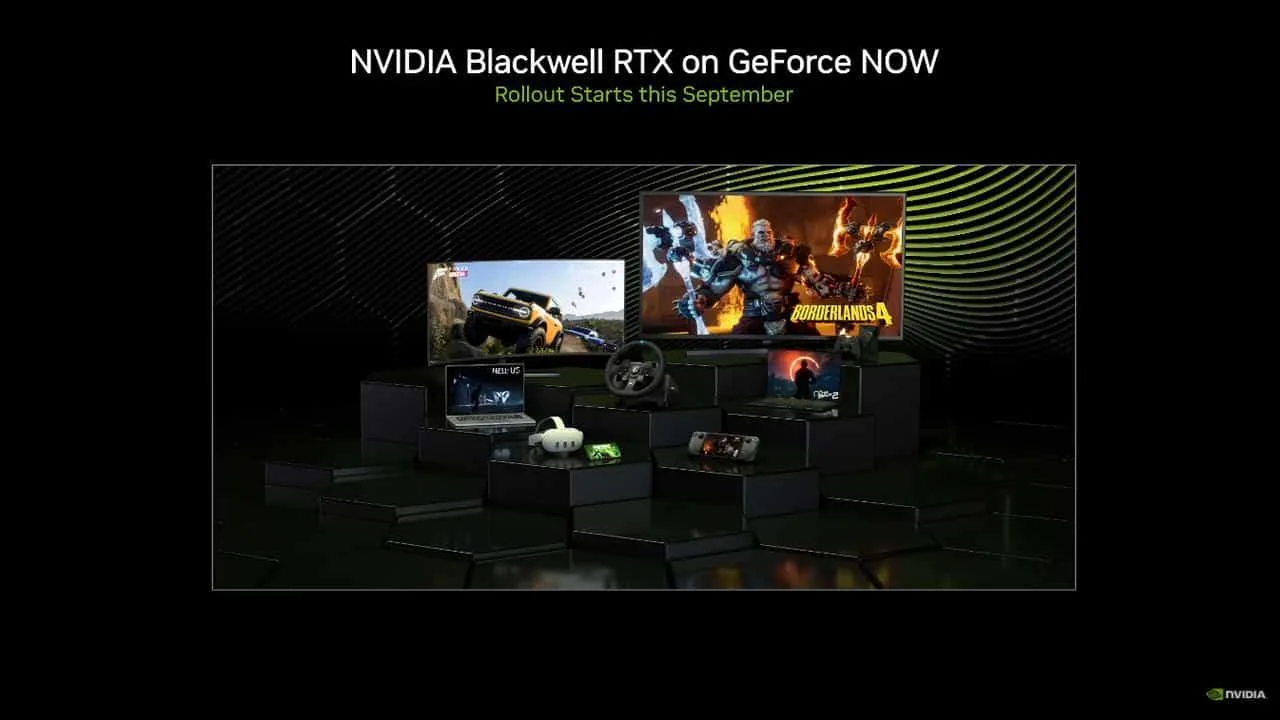
Nvidia is transforming the cloud gaming landscape once again with a sweeping set of upgrades to its GeForce Now Ultimate tier, headlined by the integration of new RTX 5080-powered servers. Alongside this, the company is debuting cinematic visual enhancements and an “install to play” system that instantly prepares new games for streaming by preloading them directly to the cloud. These improvements directly target the two biggest concerns surrounding cloud gaming—performance and responsiveness—bringing GeForce Now closer than ever to replicating the experience of a high-end gaming PC. Announced at Gamescom, these advancements reaffirm Nvidia’s ambition to make premium-quality gaming widely accessible without requiring gamers to spend thousands of dollars on new GPUs.
Remarkably, Nvidia is delivering these upgrades without raising subscription costs. The Ultimate tier will continue to be available for $19.99 per month or $99.99 for six months, with the addition of a $199.99 annual subscription option that offers a new long-term value. For those who prefer short bursts of access, Nvidia will also launch a daily membership, priced around the current $7.99 rate. Each Ultimate session remains capped at eight hours, ensuring players can enjoy extended gameplay without interruption. By maintaining its pricing while delivering performance increases equivalent to a next-generation GPU, Nvidia is positioning GeForce Now as an attractive solution for cost-conscious gamers frustrated by the soaring costs of PC hardware.
The backbone of this expansion is the switch from RTX 4080 to RTX 5080 servers, running on Nvidia’s advanced “Blackwell” architecture. These servers bring with them groundbreaking features like DLSS 4 multi-frame generation, which pushes gameplay to 5K resolution at 120 fps, and Reflex technology that enables ultra-low latency play at up to 360 fps at 1080p. Nvidia claims that most gamers in supported regions will achieve latency below 30 milliseconds, an achievement that significantly narrows the gap between cloud and local gameplay. However, not every title will immediately run at RTX 5080 performance levels—Nvidia stated that only select games will be optimized at first, with additional titles rolling out on a weekly schedule.
On the hardware side, the servers are bolstered by AMD’s Zen 5 CPUs and Nvidia’s own ConnectX-7 SmartNICs, delivering 62 teraflops of computing performance, 48GB of frame buffer, and data streaming speeds of up to 100Mbps. These capabilities are designed to deliver smooth gameplay not only on traditional PCs but also across handhelds and other platforms. Steam Deck users can expect a jump from 60 fps to 90 fps, while Lenovo’s Legion Go S will push as high as 120 fps. LG smart TVs, when paired with Windows or macOS devices, will support resolutions as high as 5120×2880, and even macOS users will gain the full benefit of GeForce Now’s upgraded app, effectively turning Apple computers into high-performance gaming machines. To round out the upgrades, Nvidia has introduced smart visual adjustments tailored to each device’s display, relying on advanced YUV color with 4:4:4 chroma sampling and AI-enhanced rendering to make sure games look consistently sharp, vibrant, and immersive across a wide range of screens.