


Dependency injection (DI) is a design pattern that allows a class to receive its dependencies from an external source rather than creating them directly. This approach promotes loose coupling, easier testing, and maintainable code. ASP.NET Core makes extensive use of DI, enabling developers to inject both framework services and custom application services into classes without tightly coupling them to specific implementations.
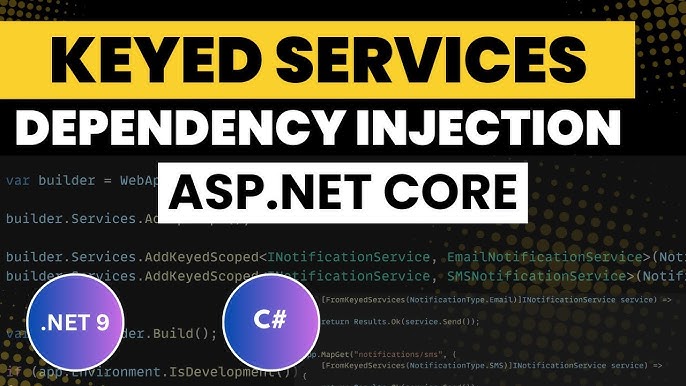
Keyed services take dependency injection a step further by allowing multiple implementations of the same interface to coexist. Each implementation is registered with a unique key, making it easy to select the correct version at runtime. This approach eliminates the need for custom factories or service locators while maintaining clean, modular, and type-safe code. For example, you might have different logger implementations for different modules of your application; keyed services let you choose the appropriate logger without duplicating code.
To get started with keyed services, you first need an ASP.NET Core Web API project. In Visual Studio 2022, create a new project using the “ASP.NET Core Web API” template. Configure it to use .NET 9.0, minimal APIs, and skip optional features like Open API support, authentication, or Docker if you don’t need them. Once the project is created, you can begin defining interfaces and multiple implementations of a service, registering each with a unique key in the dependency injection container.
Implementing keyed services improves maintainability and testability by allowing your application to easily switch between implementations at runtime. Instead of rewriting code or adding boilerplate factories, you can resolve the correct service based on the key. This approach is particularly useful for scenarios where you need multiple variations of a service, such as different loggers, data processors, or payment gateways, all coexisting in a single application. With keyed services, ASP.NET Core developers can leverage DI more effectively while keeping the application modular, clean, and flexible.