


Here’s a Quick Look at the Three Types of Class Loaders and Everything You Need to Know to Work with Them in Your Java Programs
Java class loaders are a crucial component of the Java Virtual Machine (JVM) and are responsible for loading Java classes into memory at runtime. When a Java program is executed, one or more class loaders locate and load all the classes needed to run the program. Without class loaders, the JVM would not be able to find and execute the necessary classes, making them essential for the smooth functioning of Java applications.
A Java class loader works by converting a class file into a Java class that can be executed by the JVM. This process involves locating the class file, reading its contents, and then converting it into a format that the JVM can understand. The three primary types of class loaders in Java are the bootstrap class loader, the extension class loader, and the application class loader. Each type has a specific role and function within the JVM.
The bootstrap class loader is responsible for loading the core Java classes that are required for the JVM to function. These classes are typically located in the rt.jar file, which contains the standard Java class library. The bootstrap class loader is the parent of all other class loaders and is implemented natively in the JVM. It is the first class loader to be invoked and does not have a parent class loader itself.
The extension class loader loads classes that are part of Java extensions. These classes are usually located in the lib/ext directory of the Java installation. The extension class loader is a child of the bootstrap class loader and delegates the loading of core classes to its parent. It is also known as the platform class loader in newer versions of Java.
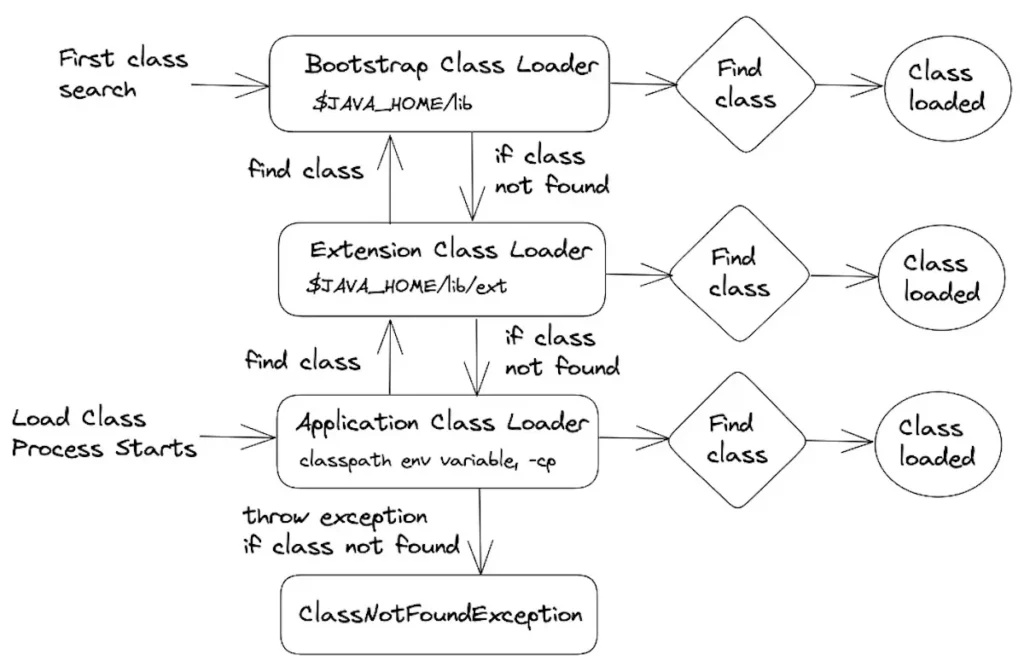
The application class loader, also known as the system class loader, loads classes that are part of the application being executed. These classes are typically located in the classpath specified for the application. The application class loader is a child of the extension class loader and delegates the loading of extension and core classes to its parent loaders. It is the default class loader used by the JVM to load application-specific classes.
Class loaders can also load classes dynamically at runtime, which allows Java programs to be more flexible and adaptable. This feature is particularly useful for applications that need to load new classes on demand or that need to load classes from remote locations or over a network. Dynamic class loading enables Java applications to extend their functionality without requiring a restart or redeployment.
Overall, Java class loaders are a critical component of the JVM that enables Java programs to load and execute classes dynamically at runtime. By understanding the different types of class loaders and how they work, developers can better manage the loading of classes in their applications and take advantage of the flexibility and adaptability that dynamic class loading offers. Whether it’s loading core Java classes, Java extensions, or application-specific classes, class loaders play a vital role in the execution of Java programs.