

Nvidia’s RTX Spark Could Reshape Portable PC Gaming Beyond AI
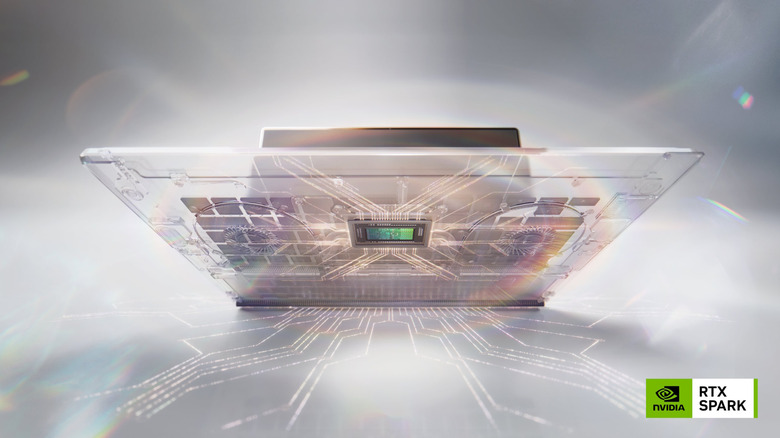
NVIDIA made one of the biggest announcements at Computex 2026 with the unveiling of RTX Spark, a new system-on-chip platform that combines Nvidia CPU and GPU technology into a single package.
While Nvidia is marketing RTX Spark primarily as a foundation for agentic AI and personal AI assistants, the platform’s hardware specifications suggest its greatest impact may ultimately be on portable gaming devices and ultrathin gaming PCs.
RTX Spark Combines Powerful CPU, GPU and Unified Memory
RTX Spark integrates a 20-core Grace CPU with a Blackwell-based RTX GPU containing 6,144 CUDA cores—the same number found in the desktop-class GeForce RTX 5070.
The platform also supports up to 128GB of unified memory, allowing the CPU and GPU to access a shared high-speed memory pool.
This architecture offers advantages for both AI workloads and gaming performance, reducing bottlenecks that typically occur when system memory and graphics memory remain separated.
Nvidia also links the CPU and GPU through its proprietary NVLink technology, providing significantly faster communication than traditional PCI Express connections.
DLSS Support Could Give Gaming Handhelds a Major Boost
Perhaps the most intriguing aspect of RTX Spark is that it becomes the first PC-focused SoC platform to support Nvidia’s DLSS 4.5 technology.
The platform includes support for:
- DLSS Super Resolution
- Ray Reconstruction
- Multi-Frame Generation
- Advanced AI-powered upscaling
These technologies have become increasingly important for modern PC gaming, allowing systems to achieve higher frame rates without requiring equivalent increases in raw rendering power.
Currently, most handheld gaming PCs rely on AMD processors and utilize AMD’s FSR upscaling technology instead. While FSR continues to improve, DLSS is generally viewed as the stronger solution for image quality and performance gains.
Potential Challenge to AMD’s Handheld Dominance
Today’s handheld PC market is dominated by AMD-powered devices such as the Asus ROG Ally X, Lenovo Legion Go and Steam Deck.
Meanwhile, the only major handheld platform currently benefiting from Nvidia-powered DLSS technology is the Nintendo Switch 2.
If RTX Spark eventually appears in gaming handhelds, Nvidia could offer significantly stronger AI-assisted gaming performance than current portable PC competitors, potentially allowing demanding titles to run at higher settings and frame rates while maintaining portable form factors.
Pricing and Power Consumption Remain Major Questions
Despite the excitement, several significant unknowns remain.
Nvidia has not disclosed:
- Power consumption figures
- Battery life estimates
- Thermal performance
- Final system pricing
Those details are especially important because RTX Spark systems may inherit pricing challenges from Nvidia’s broader AI-focused hardware lineup.
For comparison, Nvidia’s recently announced DGX Spark starts at approximately $4,699, raising concerns that high-end RTX Spark laptops and mini PCs could carry premium price tags comparable to workstation-class hardware.
A Potential Turning Point for Portable PC Gaming
Nvidia says RTX Spark-powered laptops will be capable of running modern AAA games at 1440p resolutions exceeding 100 frames per second while utilizing ray tracing and advanced rendering technologies.
If those claims translate into real-world performance while maintaining acceptable battery life and thermals, RTX Spark could become one of the most significant shifts in portable PC gaming hardware in years.
For now, RTX Spark remains positioned as an AI platform first. However, its combination of Blackwell graphics, unified memory, NVLink integration and DLSS support may ultimately prove more transformative for gamers than for the AI assistant market Nvidia is currently targeting.