

Intel has long struggled to gain traction in the desktop GPU market, holding zero percent market share, according to Jon Peddie Research. The company’s journey has been rocky, with a few rough years culminating in a 10 percent stake taken by the U.S. government. Yet the launch of the Arc Pro B50 signals that Intel isn’t ready to abandon its discrete graphics ambitions.
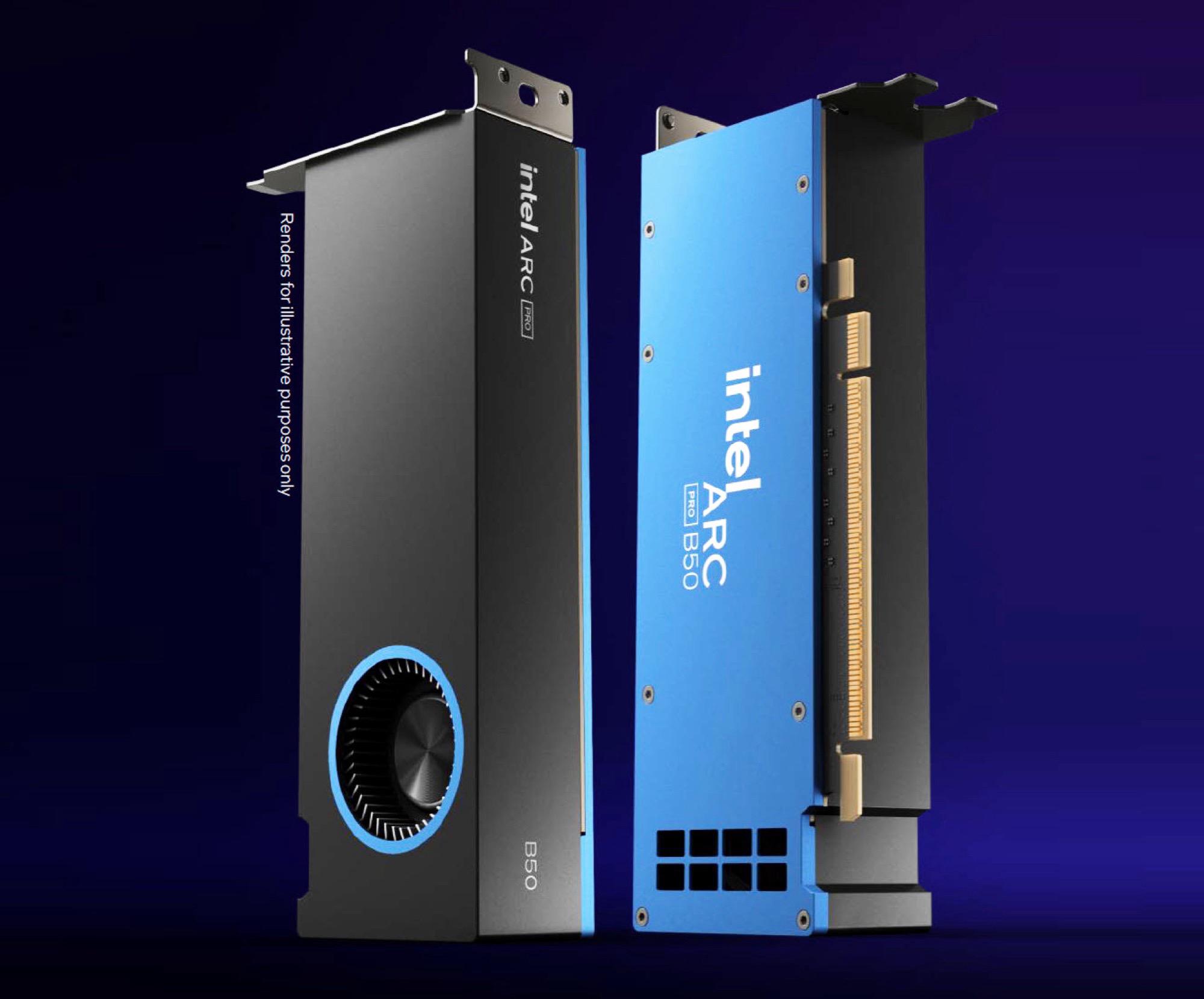
Targeted at industrial users rather than gamers, the $350 Arc Pro B50 is a lower-end sibling of the B60. Despite its compact, low-profile design that doesn’t need a dedicated power connector, the card packs 16 Xe cores, 16 ray tracing units, and 16GB of memory, with 224GB/s memory bandwidth. PCIe 5 support further boosts its performance potential. It’s perfect for rendering, AI workloads, or other professional tasks that demand compute power without the price or energy consumption of high-end cards.
Intel is also making a symbolic move by sending review units to tech outlets, signaling that the Arc Pro B50 isn’t just a paper launch. In a market where Nvidia dominates the top tier and AMD has largely retreated from it, there’s still room for an alternative. While three years after Arc’s debut the market hasn’t changed dramatically, the B50 gives at least a sliver of hope that Intel could eventually shake up the desktop GPU hierarchy.