

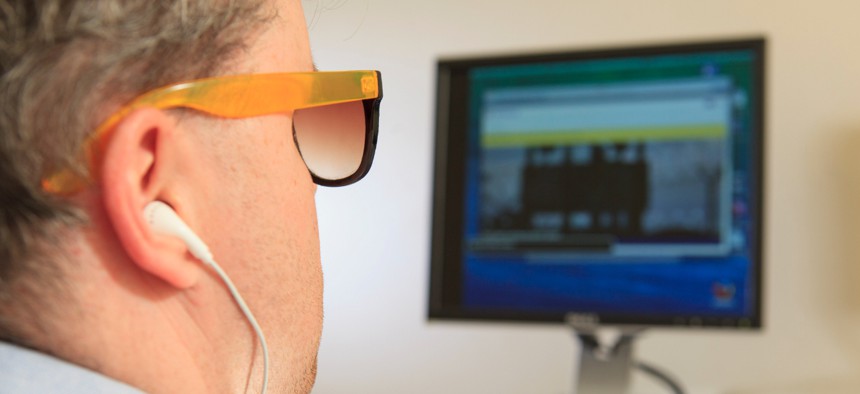
 Assistive technologies, such as screen readers, go a long way toward closing the gap between blind or partially sighted people and their sighted peers. But technologies often face obstacles because the information they are designed to work with (documents, websites, and software programs) does not work with them, leaving the information inaccessible.
There are 8 million blind or partially sighted people in the United States. More than 4.23 million of them are of working age, but only half of the working-age population is working. Employment rates for people who are blind or partially sighted have historically been much lower than for the general population.
The vast majority of jobs across all sectors require digital skills. Assistive technologies such as screen readers, screen magnifiers, and Braille note takers give people who are blind or have low vision a chance to succeed in school and the workplace.
Assistive technology has evolved and new technologies are constantly being developed for people who are blind or have low vision. Technology developed today by major tech companies for the general population often includes built-in accessibility features, such as VoiceOver on the iPhone and Narrator on Windows, both of which have text-to-speech functionality. These assistive technology advances have expanded job opportunities, and the percentage of people who are blind or partially sighted in the workforce has increased over the past decade.
FOR THOSE WHO CANNOT SEE, OUT OF SIGHT, OUT OF SIGHT
But despite the abundance of assistive technology, people who don’t rely on it are often unaware of how this technology is used in the workplace and the challenges users face with it. My colleagues and I are conducting a five-year longitudinal study to increase knowledge in this area. We hope this study can help prepare unemployed people who are blind or have low vision to enter the workforce. The study is planned to continue until 2025, with the final survey to begin in late 2024.
Digital content is sometimes technically accessible but not usable by people using assistive technology. For example, online job application systems often cause accessibility and usability challenges. Inaccessible and unusable company software means that blind or partially sighted people are often left out of tasks they could easily perform because the employer’s software does not work with screen readers.
Ross Barchacky, Inclusively’s vice president of business development and strategic partnerships, told me that job placement for people who are blind or partially sighted is more difficult than for people with other types of disabilities, due to inaccessible company software. The organization supports companies looking to hire people with disabilities, including matching them with qualified job seekers with disabilities.
DIGITAL ACCESSIBILITY
Although the Americans with Disabilities Act does not explicitly mention digital media, the Department of Justice has taken the position that ADA Title III, which covers public accommodations for people with disabilities, applies to websites and mobile applications. Thousands of digital accessibility lawsuits are filed each year under the ADA, and that number has increased significantly over the past five years.
Digital standard setters are starting to pay attention. The World Wide Web Consortium has developed standards for accessible web content: The Web Content Accessibility Guidelines have been updated in version 2.2. The guidelines provide free guidance to help developers make their digital content accessible. The two relevant standards are the US government’s Part 508 and the European Telecommunications Standards Institute’s EN 301 549. Global Accessibility Awareness Day was established in 2012 to encourage people to learn and think about digital inclusion for people with disabilities.
Despite laws and guidelines supporting an accessible digital environment, much if not all digital content is still not fully accessible. In its latest annual review of the accessibility of the top 1 million websites, the nonprofit WebAIM found an average of 50 accessibility errors per page. Worse, nearly all homepages (96.3%) had Web Content Accessibility Guidelines 2 errors.
WHAT CAN BE DONE
Accessibility can be built more easily from the beginning than by renewing it later.
Companies may require developers to create accessible software and refuse to purchase inaccessible software. Individuals can help by producing their own accessible digital documents; inaccessible digital documents were the most common workplace challenge. Microsoft is working to make it easier to produce accessible digital documents with its accessibility checker and now its new accessibility assistant.
An accessible digital environment is possible and will lead to more employment opportunities for people who are blind or have low vision.
Michele McDonnall is a research professor of rehabilitation education and research at Mississippi State University.