

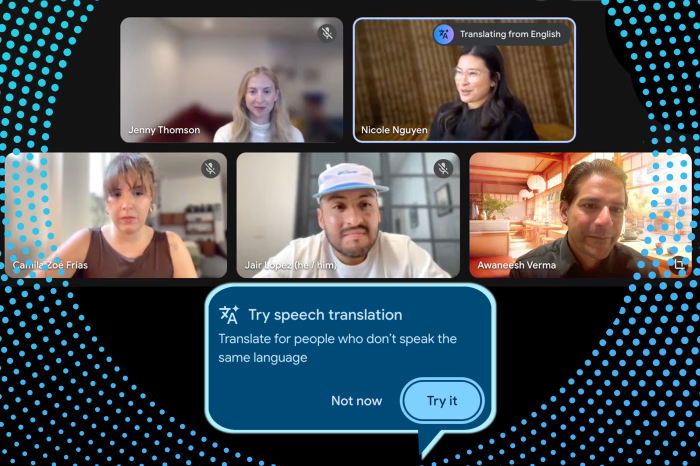
The promise of effortless, real-time translation has always been enticing, yet elusive. Google has steadily chipped away at the challenge—auto-translating web pages, offering real-time text overlays via Translate, and repurposing documents in other languages. But at Google I/O, the company unveiled what could be its most significant advance yet: Gemini-powered speech translation in Google Meet. It’s not just text on a screen—it’s your voice, translated and revoiced in real time for the person on the other end of the call.
Here’s how it works: during a Google Meet call, you speak as you normally would. On the recipient’s end, however, your words are translated and spoken aloud by an AI-generated voice, simulating the cadence and nuance of natural speech. It’s an AI-powered voiceover that turns what could have been a stilted exchange into something that resembles a genuine, flowing conversation. As Sundar Pichai noted during a media briefing, this brings us “very, very close to having a natural and free-flowing conversation across languages.”
The potential here is enormous. In professional settings—whether for virtual meetings between international teams or customer service calls spanning continents—this tool could eliminate a major communication barrier. But it’s the details that will make or break this experience. As anyone who’s used translation tools on the ground can attest, real-world language is messy. Regional dialects, slang, and informal speech often stump even the most sophisticated AI. Devices that work fine with textbook Mandarin may falter when confronted with the local dialects of Taiwan or the nuances between Mexican Spanish and Catalan.
Yet, the strength of this new voiceover feature lies in the controlled setting of a video call. Unlike the chaos of a street corner or restaurant, Google Meet provides a relatively quiet and structured environment—making AI translation far more reliable. In practical terms, it opens up more inclusive remote work environments, improves international business communication, and could even help people negotiate cross-border rentals or customer service issues with more confidence and clarity.
For now, the feature supports English-to-Spanish and Spanish-to-English translations and is being made available to Google Workspace subscribers. More languages are planned for later this year, especially for enterprise users. While it may not solve every linguistic challenge—yet—it’s a remarkable step forward in using AI to bring people closer together, no matter what language they speak.