


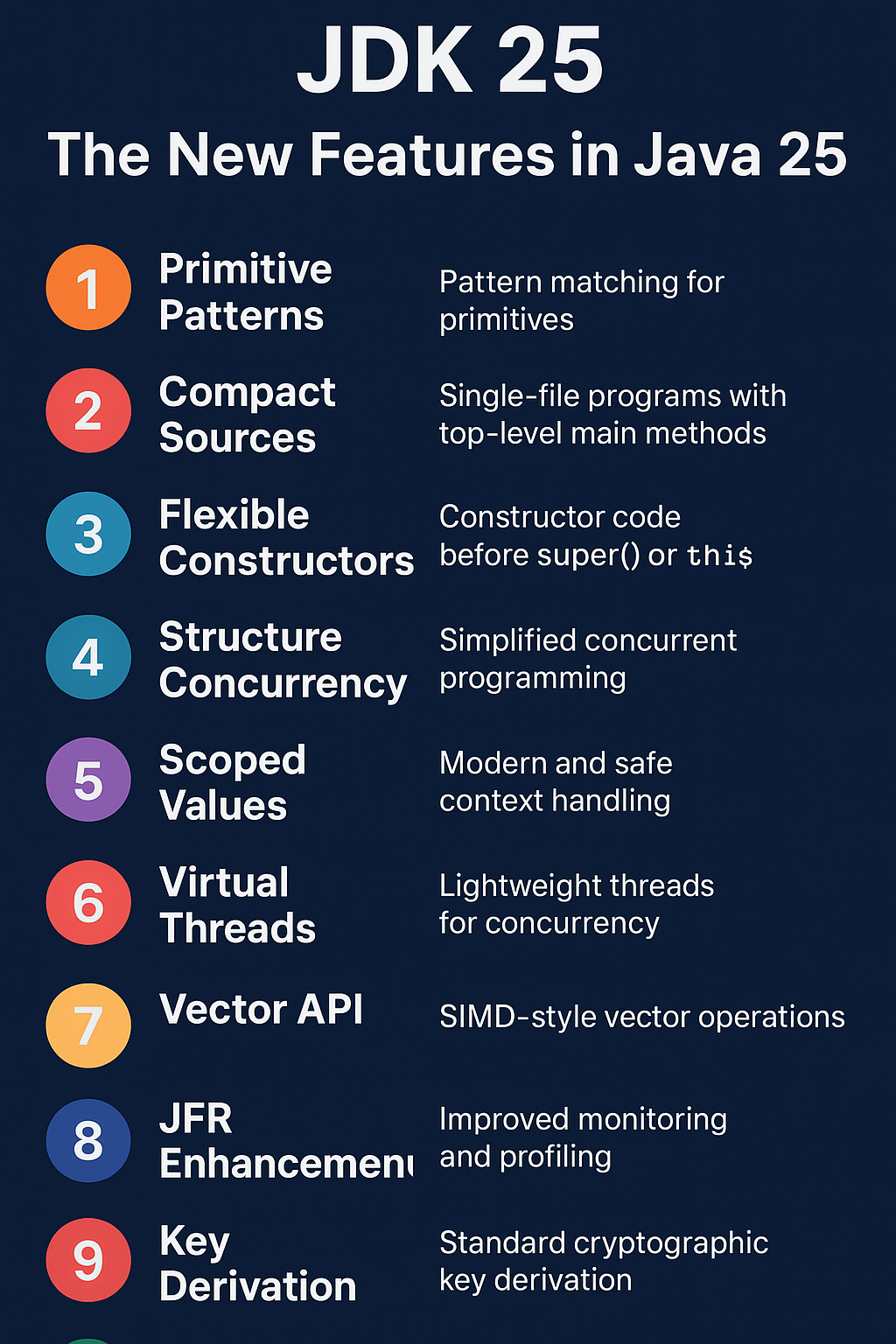
Java 25 continues the language’s evolution toward simplicity, flexibility, and improved developer experience. This latest JDK release introduces multiple enhancements that reduce boilerplate, improve readability, and make common patterns easier to implement. From simpler source files to more flexible constructors, Java 25 addresses some of the long-standing pain points for both beginners and experienced developers.
One of the most noticeable changes is the introduction of compact source files and instance main methods through JEP 512. Writing a basic program no longer requires verbose class and method declarations. Instead of the traditional public class HelloWorld { public static void main(String[] args) { ... } }, developers can now write a concise void main() { IO.println("Hello, World!"); }. This improvement eliminates boilerplate and makes learning Java easier, while the IO libraries are now included in java.lang, removing the need for explicit imports.
JDK 25 also introduces flexible constructor bodies via JEP 513. Previously, Java constructors were rigid, requiring super() or this() to be the first statement. Now, developers can execute initialization logic before calling the superclass constructor, making code more readable and logical. For instance, calculating a rectangle’s area before passing it to a superclass constructor is now straightforward, avoiding awkward static helper methods and improving maintainability of class hierarchies.
Another notable improvement is JEP 511, which allows wholesale module imports. Instead of importing individual packages one by one, developers can import an entire module in one statement. This simplifies the organization of large projects and reduces repetitive import statements. Combined, these features reflect Java’s continued commitment to developer productivity, readability, and streamlined code, making JDK 25 a compelling upgrade for modern Java development.