

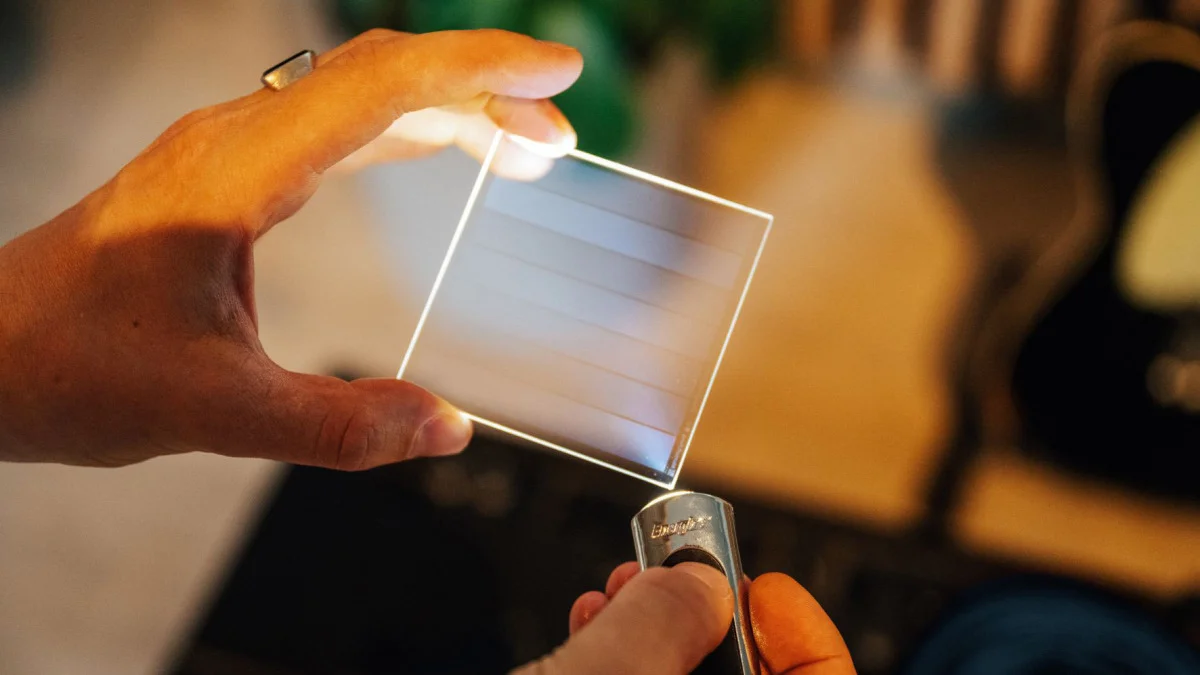
Microsoft has announced a major milestone for Project Silica, its long-running effort to store digital data in glass as an ultra-durable archival medium. The company says it can now successfully encode information into borosilicate glass—the same type of glass commonly used in oven doors and laboratory containers—bringing the technology closer to commercial viability.
Until now, Project Silica relied on specialized fused glass suitable for research but impractical for large-scale deployment. By switching to widely available borosilicate glass, Microsoft aims to make the storage method easier and cheaper to produce. The goal of the project is long-term preservation: Microsoft claims the glass medium could retain data for more than 10,000 years without degradation.
The system encodes information holographically into glass sheets roughly 2mm thick. Earlier demonstrations included archiving films and music to test durability and longevity. Traditional storage media such as hard drives, magnetic tapes, and optical discs can suffer from “bit rot” and physical wear over time, making them unreliable for extremely long-term preservation.
Microsoft says recent advances have improved how data is written to the glass. Instead of relying solely on polarization methods, the company now uses “phase voxels,” which allow more data points to be written in parallel. Machine learning tools are also being used to optimize encoding and model how the stored data might age over centuries.
Although Microsoft says the research phase of Project Silica is largely complete, it has not announced production timelines. The company noted it will evaluate next steps toward commercialization while continuing to refine the technology. Findings from the latest experiments have been published in the journal Nature.
If brought to market, glass-based storage could become a new standard for long-term digital archiving in data centers, cultural institutions, and governments. For now, however, practical deployment remains a future goal.