

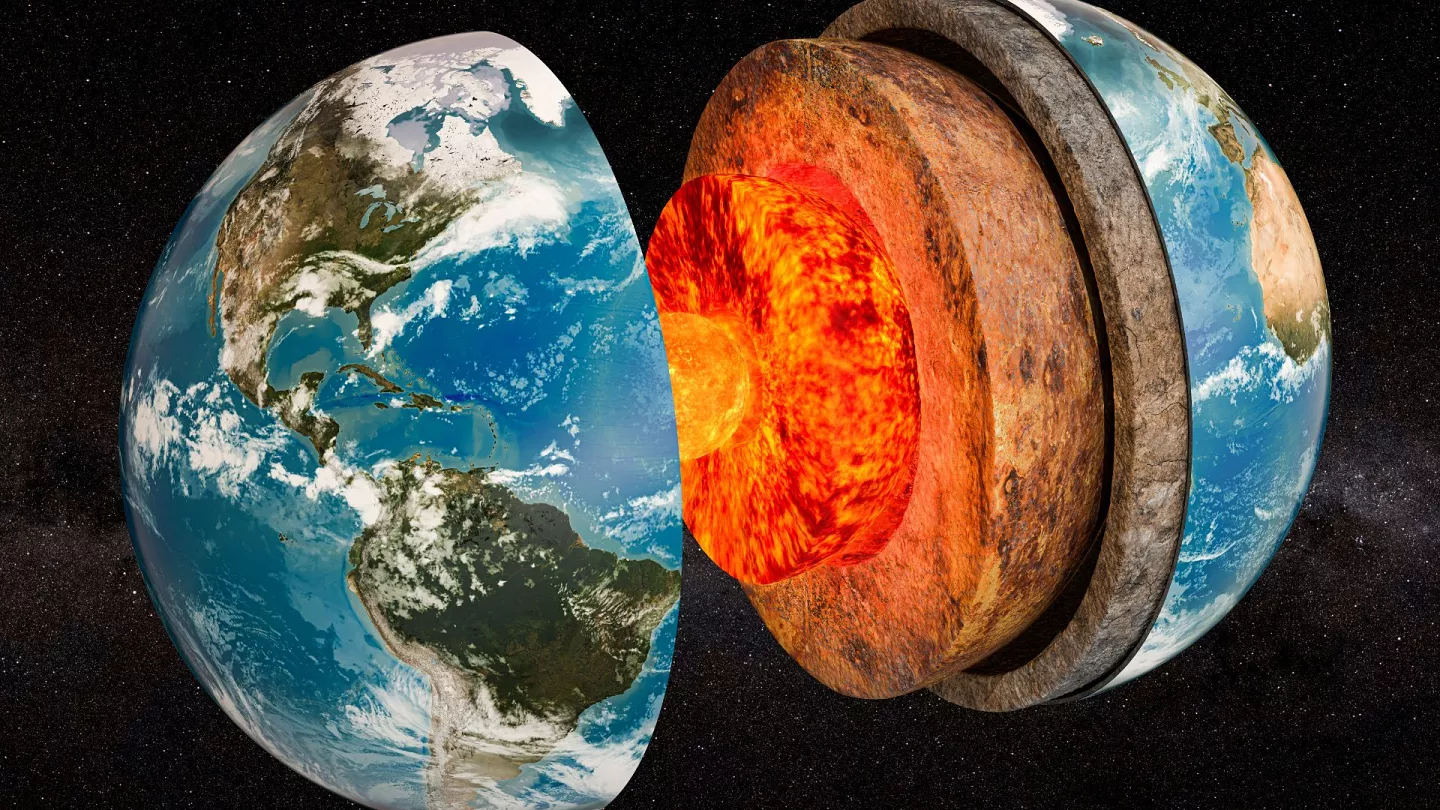

In 2024, scientists made a discovery that sounds like science fiction: the Earth’s core had dramatically slowed its movement compared to the crust above, and in some cases seemed to pause altogether. Despite how striking this sounds, most people would never notice it in everyday life, but the finding has reshaped our understanding of the planet’s deep interior.
At the heart of Earth lies its core, made almost entirely of iron and nickel. This core has two distinct layers: a liquid outer core, whose turbulent flow generates the magnetic field protecting us from cosmic radiation, and a solid inner core, compressed to extreme density and heated to nearly 5,700°C. The transition from mantle to outer core lies about 1,800 miles beneath the surface, while the inner core begins at a depth of about 3,200 miles. Studying these regions directly is impossible, so researchers rely on seismic waves from earthquakes, which pass through the Earth and carry subtle clues about what’s happening inside.
For decades, the prevailing view was that the inner core rotated at a steady, independent rate, like a perfectly tuned machine hidden beneath the crust. But detailed seismic analysis showed otherwise: its rotation is uneven, sometimes outrunning the crust, other times lagging behind. When it slows enough, the difference makes it look as if the core has stopped moving or is even reversing direction, though in reality it never actually halts. Instead, the relative speed changes dramatically over time. Evidence now suggests these changes follow a 70-year cycle, with shifts in pace roughly every 35 years.
The most recent slowdown began in 2009, when the core and crust were moving almost in lockstep before the core gradually began to lag. These variations may sound minor, but they ripple outward in subtle but important ways. For example, the length of a day can change by a few milliseconds depending on the rotational balance between crust and core. That’s imperceptible to humans but matters for astronomy, navigation systems, and satellite orbits. There are also potential connections to magnetic field fluctuations and even climate dynamics, though research is still ongoing. What’s clear is that the Earth is not the stable, static world it sometimes seems to be—beneath our feet, its innermost layers are in constant motion, shaping the environment we depend on.