

JetBrains 2023 Report Highlights C++ Developer Preferences and Tools
JetBrains’ annual Developer Ecosystem Survey provides a comprehensive overview of the current state of software development, capturing key trends and shifts across various programming languages and tools. The 2023 results are in, and one of the standout trends is the rapid adoption of AI tools among developers. A staggering 77% of respondents reported using ChatGPT for various work-related tasks, highlighting the increasing integration of AI in the development workflow. Meanwhile, older languages like Objective-C are fading in popularity, and newer languages like Rust continue to rise, showcasing the evolving landscape of software development.
This year’s survey gathered insights from 34,493 software developers worldwide, with 2,627 identifying C++ as one of their top three primary languages. The survey provides a deep dive into the preferences and practices of C++ developers, covering everything from the most commonly used language versions to the preferred IDEs, build tools, and package managers. To add further depth to the analysis, JetBrains consulted with several prominent members of the C++ community, including Inbal Levi from WG21, Bryce Adelstein Lelbach of Nvidia, and Diego Rodriguez-Losada Gonzalez from JFrog, to provide expert perspectives on the data.
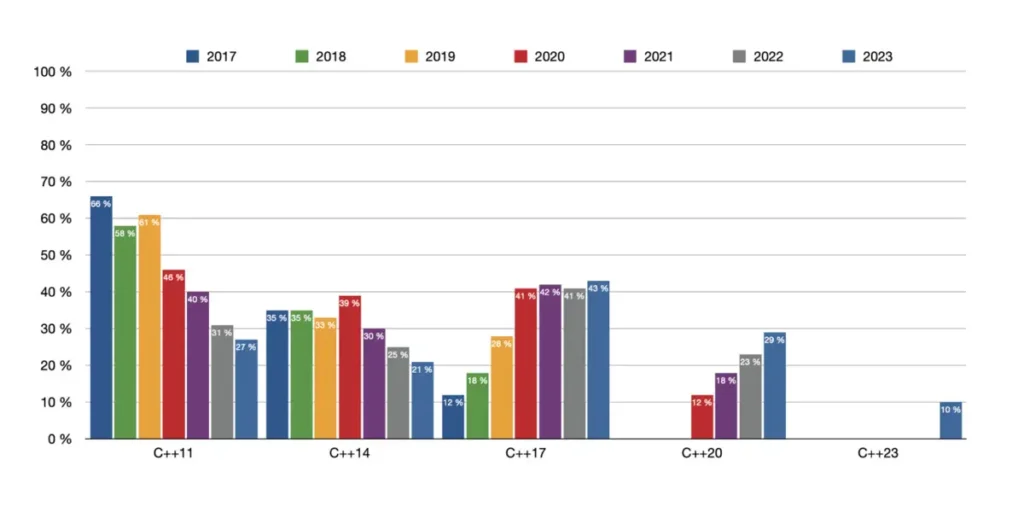
Among the key findings, the migration away from older C++ standards like C++11 and C++14 continues, with developers increasingly adopting newer versions such as C++20 and C++23. The data suggests that by next year, the combined usage of C++20 and C++23 could surpass that of C++17, driven in part by the focus of recent C++ conferences on newer standards. This trend is indicative of a community that is eager to leverage the modern features and optimizations offered by the latest C++ versions.
Interestingly, the survey also explores the tools and environments C++ developers favor. IDE preferences reveal a strong leaning towards tools like Visual Studio and CLion, while package managers like Conan are becoming more popular for dependency management in C++ projects. The rise of modern build systems and code analysis tools is also highlighted, reflecting a shift towards more sophisticated development workflows and an emphasis on code quality.
Moreover, the survey delves into the growing interest in alternative languages like Rust, Carbon, and Cppfront. While C++ remains a robust choice for systems-level programming, developers are keeping an eye on these emerging languages that offer different paradigms and potential advantages in safety and performance. The insights shared by community experts indicate that while C++ is evolving, it is also facing healthy competition from these newer contenders.
In conclusion, the 2023 Developer Ecosystem Survey by JetBrains sheds light on the dynamic nature of the C++ community and its adoption of new standards, tools, and practices. As C++ continues to evolve, it remains a foundational language in the software development landscape, adapting to meet the needs of modern developers while contending with both old and new challenges. The insights provided by industry experts only reinforce the vitality of the C++ ecosystem as it progresses into the future.