


Close Menu
Şevket Ayaksız
    What's Hot

    AI watermarks could improve transparency but won’t stop AI slop

    Eylül 13, 2026

    LG’s 4K OLED gaming monitor gets a $600 discount

    Eylül 13, 2026

    Keychron’s 100-key macropad offers 8,000Hz polling for $65

    Eylül 13, 2026
    • software
    • Gadgets
    Şevket AyaksızŞevket Ayaksız
    • Home
    • Technology

      Apple: iPhone 17 and Older Models Hit With Unexpected $100 Price Increase

      Eylül 10, 2026

      Apple Watch Intelligence Could Be a Major Accessibility Breakthrough

      Eylül 10, 2026

      Apple May Skip the Base iPhone 18 This Year

      Eylül 10, 2026

      FCC changes robot vacuum rules, potentially affecting future models

      Ağustos 8, 2026

      Samsung’s new 2TB 990 SSD drops to its lowest price yet

      Ağustos 6, 2026
    • Adobe

      Adobe brings four key creative apps to Windows on Arm beta

      Ağustos 1, 2025

      Skip the Legal Jargon—Adobe Acrobat’s AI Reads Contracts for You

      Şubat 5, 2025

      Save 50% on a Top-Rated Adobe Alternative This Black Friday

      Kasım 30, 2024

      Save 50% on Adobe’s Creative Cloud This Black Friday

      Kasım 25, 2024

      Adobe Brings Generative AI to Premiere Pro for Smarter Video Editing

      Ekim 24, 2024
    • Microsoft

      Microsoft quietly removes Windows 11’s 32GB RAM recommendation

      Ağustos 6, 2026

      Microsoft aims to improve Windows 11 performance on 8GB PCs

      Ağustos 2, 2026

      Microsoft PowerToys remains an essential Windows utility

      Temmuz 31, 2026

      Microsoft says Windows Secure Boot certificate rollout is still in progress

      Temmuz 30, 2026

      Microsoft tests Windows Update changes after major outage

      Temmuz 29, 2026
    • java

      Optimizing Java Streams for High-Performance Applications

      Aralık 20, 2025

      AI Brings a New Spark to JavaScript Programming

      Kasım 9, 2025

      Revisiting the Spring Framework: What’s New and Why It Still Matters

      Kasım 9, 2025

      Top Highlights and Features to Watch in Java 25

      Kasım 3, 2025

      Mastering Java Cold Starts: Achieving High-Performance Serverless with GraalVM and Spring

      Kasım 3, 2025
    • Oracle

      JavaScript Community Pushes Back Against Oracle’s Trademark Claim

      Şubat 8, 2025

      Understanding the Impact of the Google vs. Oracle Decision

      Aralık 25, 2024

      Google Wins Legal Battle Over Java, Oracle Continues to Resist

      Aralık 25, 2024

      Oracle Unveils Verrazzano: A New Container Platform for Kubernetes

      Aralık 12, 2024

      Oracle vs. Google: Implications of the Verdict on Open Source Software

      Aralık 8, 2024
    Şevket Ayaksız
    Anasayfa » Implementing the Command Pattern in Java: Streamlining Application Control and Flexibility
    java

    Implementing the Command Pattern in Java: Streamlining Application Control and Flexibility

    By mustafa efeTemmuz 9, 2024Yorum yapılmamış3 Mins Read
    Facebook Twitter Pinterest LinkedIn Tumblr Email
    Share
    Facebook Twitter LinkedIn Pinterest Email

    Mastering Java: Harnessing the Command Pattern for Enhanced Program Control

    In the realm of software development, managing complexity and ensuring code maintainability are paramount concerns. The Command pattern provides a structured approach to address these challenges by encapsulating actions as objects, thereby promoting loose coupling between the sender and receiver of requests. This design pattern derives its name from the notion of a command—a request wrapped in an object—which allows for the decoupling of the object making the request (client) from the object that handles the request (receiver).

    Imagine a scenario akin to using a remote control for a television. Each button press on the remote corresponds to a specific command: turning the TV on or off, changing channels, adjusting volume, and so forth. Each of these commands is encapsulated within the remote control device, enabling the user to execute them in sequence or individually. This encapsulation not only simplifies the remote’s usage but also facilitates operations like undoing the last command executed—a feature commonly supported by Command pattern implementations.

    From a design perspective, the Command pattern aligns closely with two fundamental principles of object-oriented design: the Single Responsibility Principle (SRP) and the Open-Closed Principle (OCP). According to SRP, each class should have only one reason to change, which in the context of Command pattern means that each Command object should encapsulate a single action. This ensures that changes to one command do not affect others, enhancing code modularity and maintainability. The OCP dictates that software entities should be open for extension but closed for modification, a principle exemplified in the Command pattern by allowing new commands to be added without altering existing client or receiver code.

    Introduced as part of the Gang of Four (GoF) design patterns, the Command pattern has evolved alongside advancements in programming paradigms. Java, for instance, initially implemented Command pattern using traditional object-oriented techniques. With the introduction of lambda expressions in Java 8, the Command pattern gained a functional programming perspective, enabling a more concise and expressive approach to defining commands as functions or methods. This functional shift provides developers with greater flexibility in implementing command-based systems, particularly in scenarios requiring dynamic or conditional command execution.
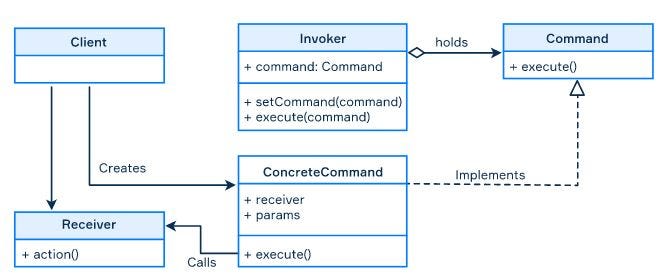


    Applying the Command pattern effectively requires a nuanced understanding of its strengths and limitations. While it excels in scenarios demanding decoupled, reusable command execution, its utility may diminish in simpler applications or where other patterns like Strategy or Observer might offer more straightforward solutions. Thus, selecting the appropriate design pattern hinges on recognizing the specific requirements and constraints of each software project.

    When it was first introduced, the Command pattern was sometimes explained as callbacks for Java. While it started out as an object-oriented design pattern, Java 8 introduced lambda expressions, allowing for an object-functional implementation of the Command pattern. This article includes an example using a lambda expression in the Command pattern.

    In summary, the Command pattern stands as a testament to the power of abstraction and encapsulation in software design. By encapsulating requests as objects, it not only simplifies command execution and management but also enhances code flexibility, scalability, and maintainability—a testament to its enduring relevance in modern software architecture.

    Post Views: 412
    java Programming Languages Software Development
    Share. Facebook Twitter Pinterest LinkedIn Tumblr Email
    mustafa efe
    • Website

    Related Posts

    Optimizing Java Streams for High-Performance Applications

    Aralık 20, 2025

    AI Brings a New Spark to JavaScript Programming

    Kasım 9, 2025

    Revisiting the Spring Framework: What’s New and Why It Still Matters

    Kasım 9, 2025
    Add A Comment

    Comments are closed.

    Editors Picks
    8.5

    Apple Planning Big Mac Redesign and Half-Sized Old Mac

    Ocak 5, 2021

    Autonomous Driving Startup Attracts Chinese Investor

    Ocak 5, 2021

    Onboard Cameras Allow Disabled Quadcopters to Fly

    Ocak 5, 2021
    Top Reviews
    9.1

    Review: T-Mobile Winning 5G Race Around the World

    By sevketayaksiz
    8.9

    Samsung Galaxy S21 Ultra Review: the New King of Android Phones

    By sevketayaksiz
    8.9

    Xiaomi Mi 10: New Variant with Snapdragon 870 Review

    By sevketayaksiz
    Advertisement
    Demo
    Şevket Ayaksız
    Instagram
    • Home
    • Adobe
    • microsoft
    • java
    • Oracle
    • Contact
    © 2026 Theme Designed by Şevket Ayaksız.

    Type above and press Enter to search. Press Esc to cancel.